
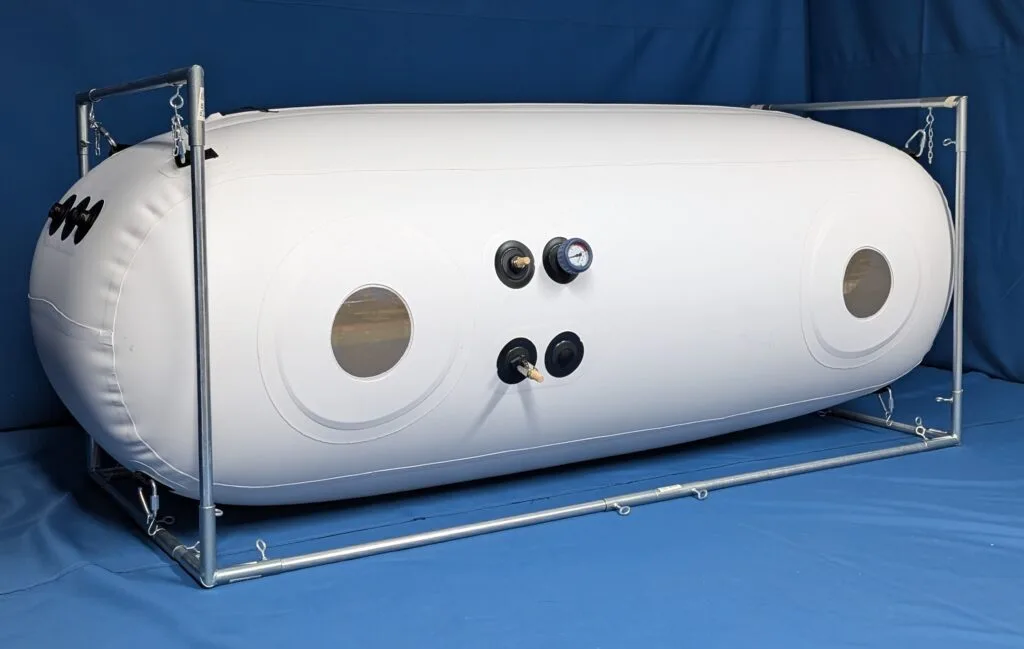
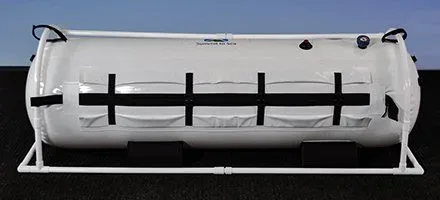
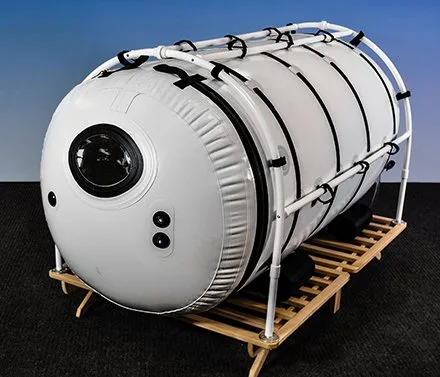
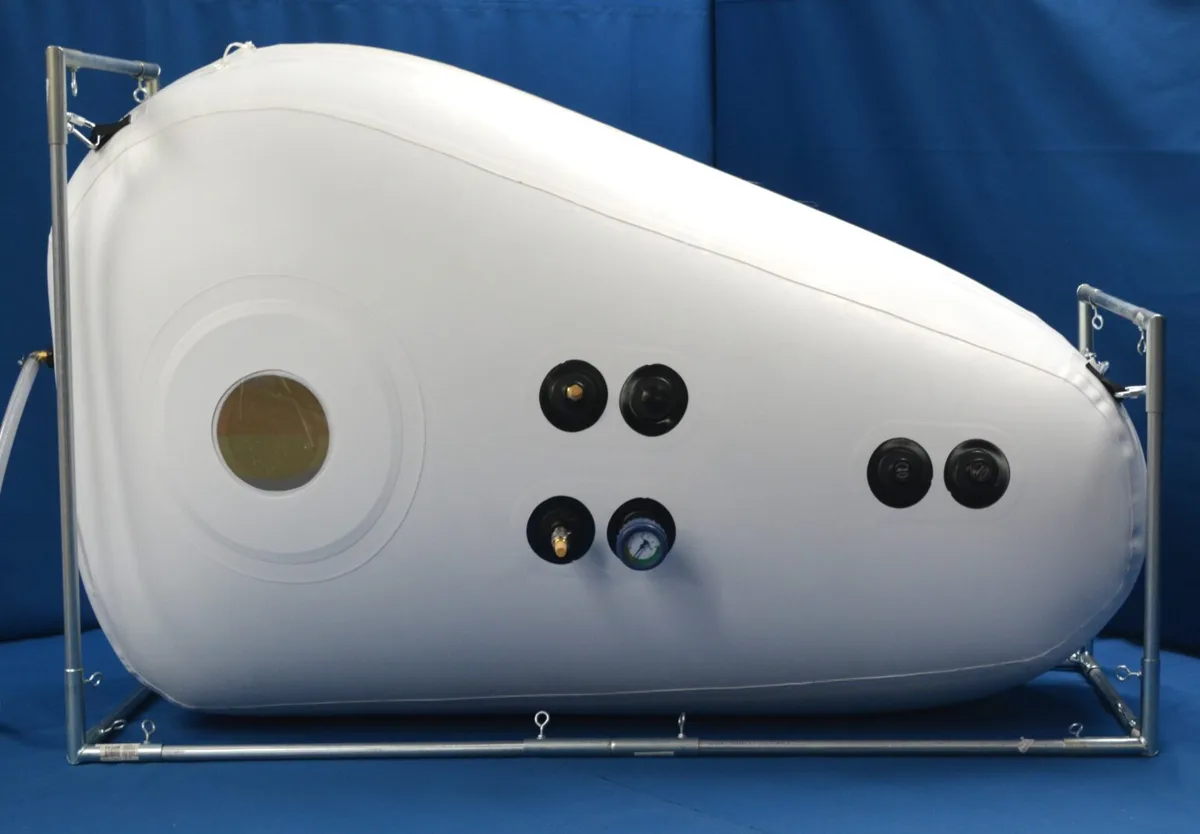
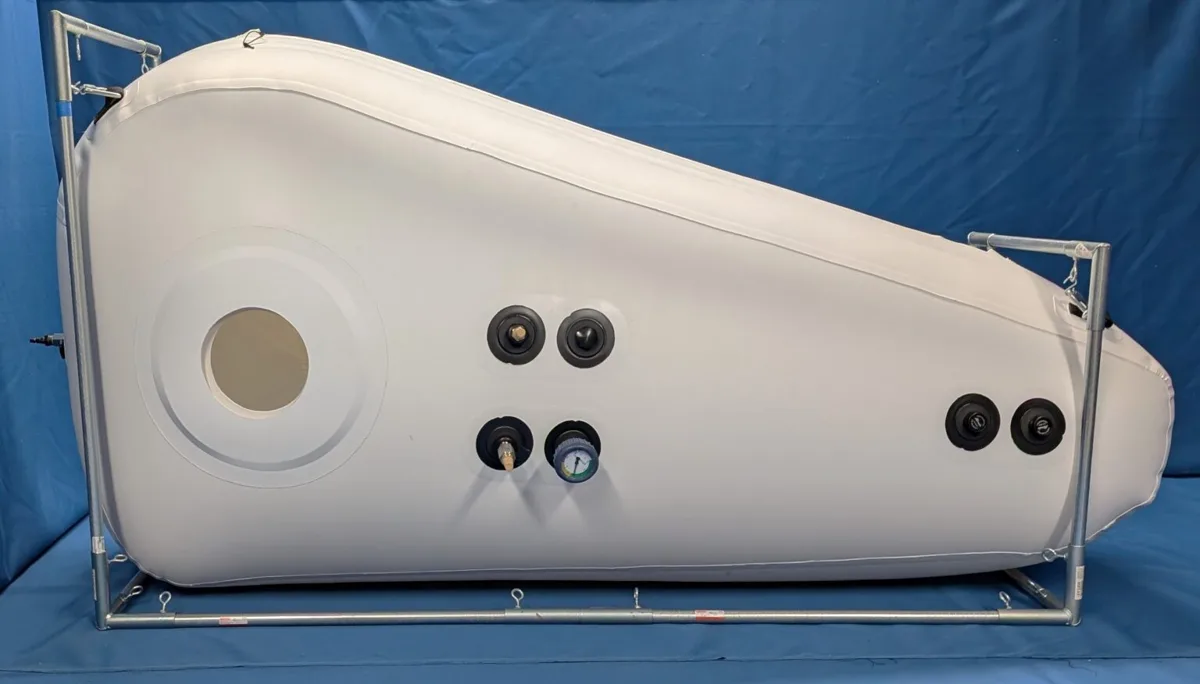
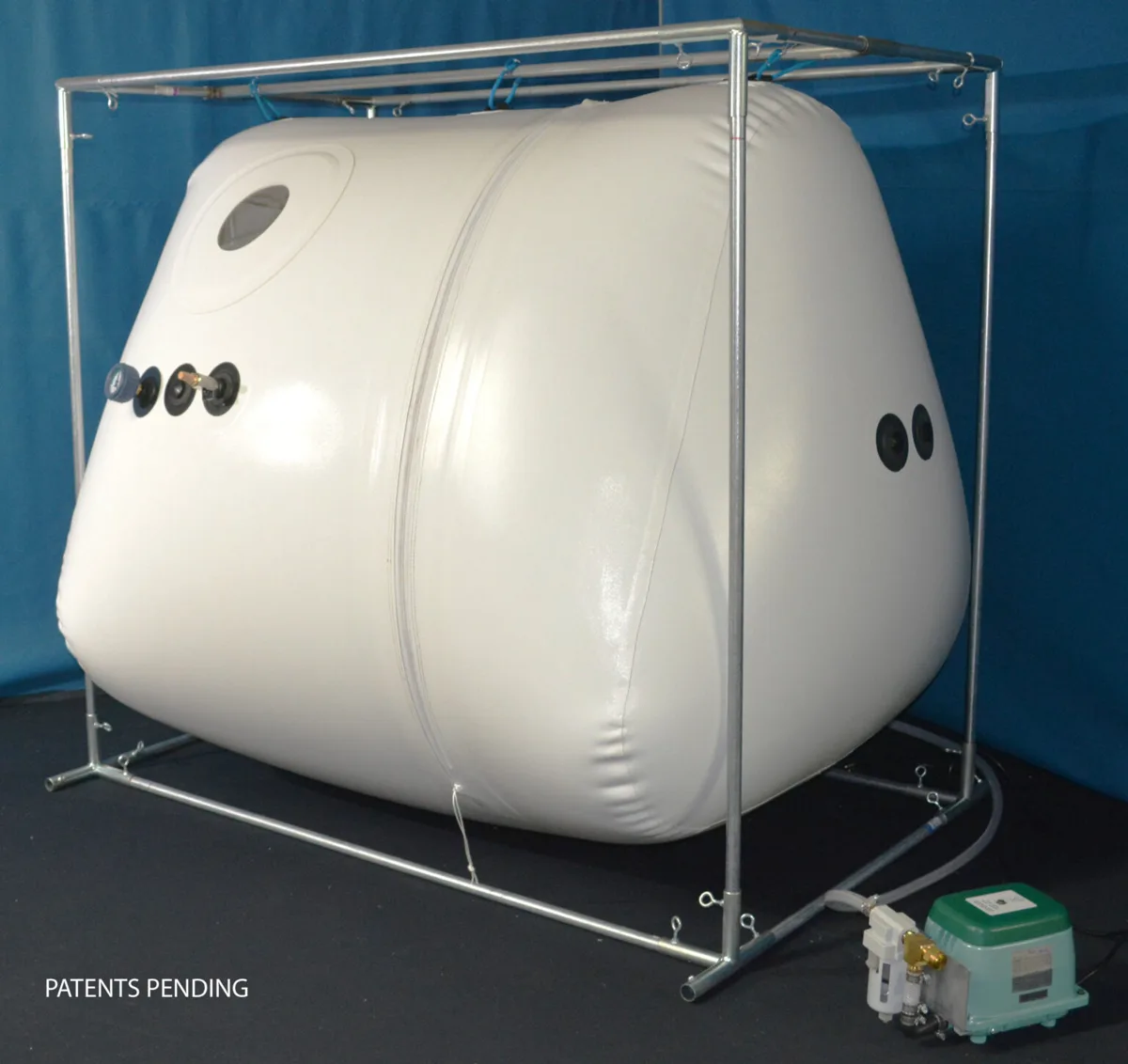
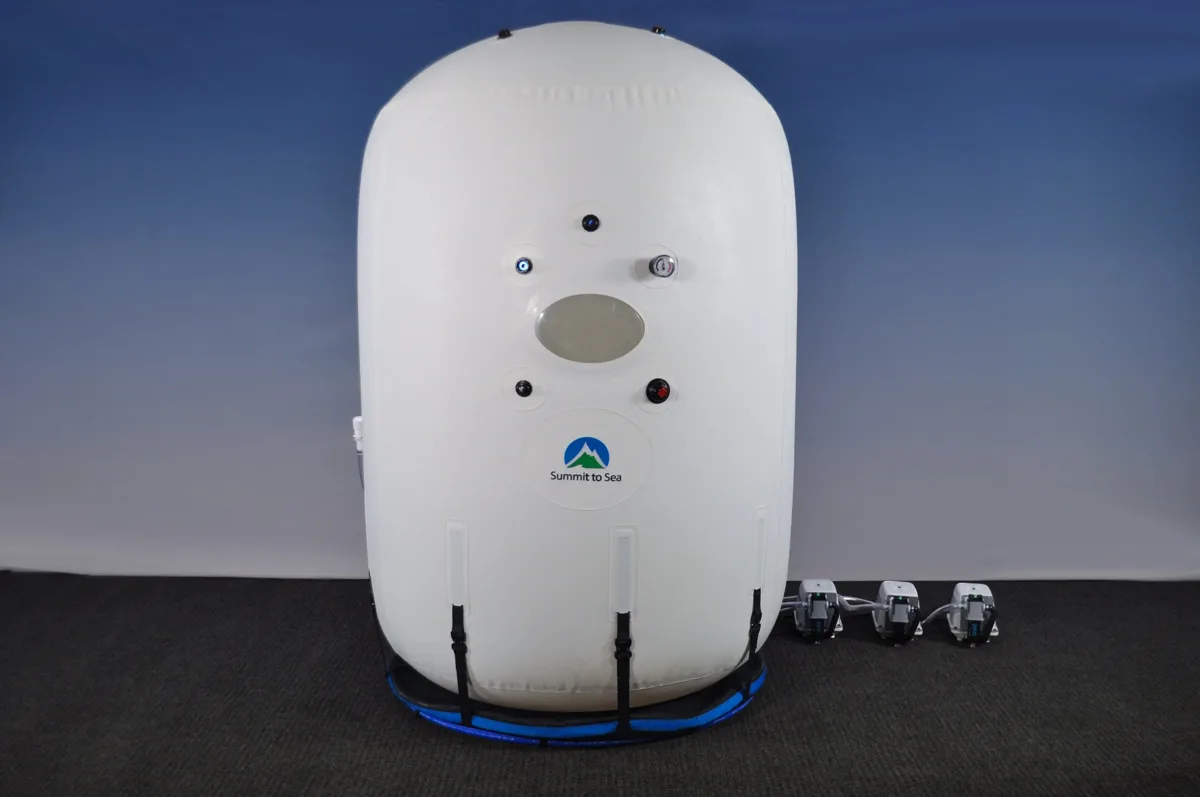
Home hyperbaric chambers at a glance
Live from our catalog of 12 models from 2 makers. Prices are each maker's starting price for the base option, as last checked on the maker's site.
| Type | Models | Lowest | Median | Highest |
|---|---|---|---|---|
| Lie-flat soft chamber | 7 | $4,095 | $8,995 | $20,195 |
| Seated soft chamber | 5 | $4,895 | $8,195 | $17,995 |
Makers in this category
| Maker | Based in | Models | From | Products with maker-stated Made in USA |
|---|---|---|---|---|
| Newtowne Hyperbarics | Pocomoke City, Maryland | 6 | $4,095 | 0 |
| Summit to Sea | Minnesota | 6 | $7,995 | 0 |
Head to head: the five matched pairs we carry
Summit to Sea and Newtowne both build soft 1.3 ATA chambers in the United States, and five of their models line up closely enough to compare directly. Every number below comes from the two makers' own product pages. We only compare models we sell, and where one maker does not state a figure we say so rather than guess.
In short: Newtowne is the lower price at every matched size, includes shipping on its smaller chambers and states a 2 year warranty. Summit to Sea runs slightly higher pressure (4.4 psi vs 4 psi), ships two redundant compressors on every lie flat model, and its larger seated chamber has no Newtowne equal.
| Size class | Summit to Sea model | Newtowne model | Summit from | Newtowne from |
|---|---|---|---|---|
| Compact lie flat (about 26 to 27 in) | Shallow Dive 26 in | A4-27 | $7,995 | $4,095 |
| Mid lie flat (33 to 34 in) | Dive 33 in | A4-34 | $9,995 | $5,795 |
| Large lie flat (40 in) | Grand Dive 40 in | A4-40 | $13,995 | $8,995 |
| Seated | Dive Vertical (40 in x 85 in tall) | Shoe / Long Shoe | $13,995 | $4,895 / $5,495 |
| Walk in or large seated | Grand Dive Vertical 60 in | Tent walk in | $17,995 | $8,195 |
| Extra wide lie flat | Grand Dive Pro 46 in | No match | $20,195 | n/a |
Sources: Summit to Sea product pages (summit-to-sea.com) and Newtowne Hyperbarics product pages (newtownehyperbarics.com), read Oct 26, 2026 (PT). Prices are maker starting prices; check the maker before ordering.
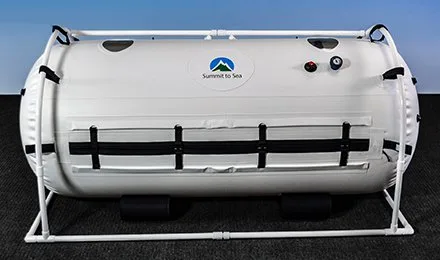
Summit to Sea Shallow Dive 26 vs Newtowne A4-27
The two smallest lie flat chambers we carry. Both suit one adult of average build and fold small for storage. The Newtowne costs about half as much but its 4 inch mattress is a $275 upgrade; the Summit ships with a foam mat, frame and a second compressor for redundancy.
| Spec | Summit to Sea | Newtowne |
|---|---|---|
| Pressure | 4.4 psi (1.3 ATA) | 4 psi (1.3 ATA) |
| Size | 26 in x 84 in | 27 in x 84 in at pressure |
| Compressors | 2 redundant, in line filtration | 1 x 80L |
| Windows | 1 | 1 viewport, 2 accessory ports |
| Included | Frame, foam mat, bolster cradle, carry case | Steel frame 29.75 x 67.5 in; mattress $275 extra |
| Power | 120V, 15 amp outlet | 120V household outlet |
| Shipping | See maker | Included |
| Warranty | See maker | 2 years |
| From | $7,995 | $4,095 |
Sources: Summit to Sea product pages (summit-to-sea.com) and Newtowne Hyperbarics product pages (newtownehyperbarics.com), read Oct 26, 2026 (PT). Prices are maker starting prices; check the maker before ordering.
Summit to Sea Dive 33 vs Newtowne A4-34
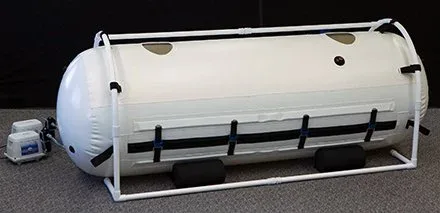
The most popular middle size. The Newtowne A4-34 is longer (95 in) and includes an internal gauge and mattress; the Summit Dive adds a second compressor and two windows on an external frame.
| Spec | Summit to Sea | Newtowne |
|---|---|---|
| Pressure | 4.4 psi (1.3 ATA) | 4 psi (1.3 ATA) |
| Size | 33 in x 90 in | 34 in x 95 in at pressure |
| Compressors | 2 redundant, in line filtration | 120L standard |
| Windows | 2 | 2 viewports |
| Included | External frame, foam mat, bolster cradle, carry case | Internal gauge, 4 in mattress with cover, steel frame 36.75 x 77.5 in |
| Power | 120V, 15 amp outlet | 120V household outlet |
| Shipping | See maker | Included |
| Warranty | See maker | 2 years |
| From | $9,995 | $5,795 |
Sources: Summit to Sea product pages (summit-to-sea.com) and Newtowne Hyperbarics product pages (newtownehyperbarics.com), read Oct 26, 2026 (PT). Prices are maker starting prices; check the maker before ordering.
Summit to Sea Grand Dive 40 vs Newtowne A4-40
The Grand Dive is the chamber Gemini named first for best home hyperbaric chamber in our Oct 29 check, and it is the one to look at if two people, or a parent and child, will share sessions. The Newtowne A4-40 is the same diameter but 18 inches longer, at a lower price plus $400 freight.
| Spec | Summit to Sea | Newtowne |
|---|---|---|
| Pressure | 4.4 psi (1.3 ATA) | 4 psi (1.3 ATA) |
| Size | 40 in x 90 in | 40 in x 108 in at pressure |
| Weight | About 50 lb | See maker |
| Compressors | 2 redundant, in line filtration | 120L |
| Windows | 2 | 2 viewports |
| Included | See maker page | Internal gauge, 4 in mattress with cover, steel frame 41.75 x 88.5 in |
| Shipping | See maker | $400 |
| Warranty | See maker | 2 years |
| From | $13,995 | $8,995 |
Sources: Summit to Sea product pages (summit-to-sea.com) and Newtowne Hyperbarics product pages (newtownehyperbarics.com), read Oct 26, 2026 (PT). Prices are maker starting prices; check the maker before ordering.
Seated chambers: Summit to Sea Dive Vertical vs Newtowne Shoe and Long Shoe
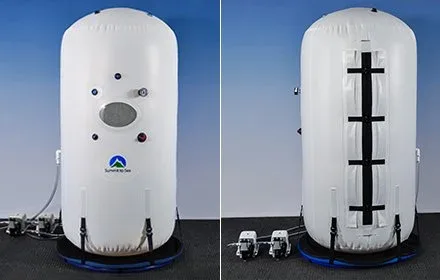
Seated chambers suit anyone who finds lying in a tube confining or getting down to the floor hard. The Summit Dive Vertical is a tall upright cylinder with a 5 foot double sided zipper. The Newtowne Shoe and Long Shoe are lower, longer shapes you sit in with legs forward; neither includes a chair or mat.
| Spec | Summit Dive Vertical | Newtowne Shoe | Newtowne Long Shoe |
|---|---|---|---|
| Pressure | 1.3 ATA | 4 psi (1.3 ATA) | 4 psi (1.3 ATA) |
| Size | 40 in dia x 85 in tall | 68 x 37 x 42 in tall | 81 x 37 x 42 in tall |
| Compressors | 2 redundant | 80L | 80L |
| Entry | 5 ft double sided zipper | See maker | See maker |
| Included | See maker | 2 viewports; no chair or mat | 2 viewports; no chair or mat |
| Shipping | See maker | Included | Included |
| Warranty | See maker | 2 years | 2 years |
| From | $13,995 | $4,895 | $5,495 |
Sources: Summit to Sea product pages (summit-to-sea.com) and Newtowne Hyperbarics product pages (newtownehyperbarics.com), read Oct 26, 2026 (PT). Prices are maker starting prices; check the maker before ordering.
Walk in: Summit to Sea Grand Dive Vertical 60 vs Newtowne Tent
The two largest upright chambers we carry, for wheelchair access, two seated adults or anyone who wants to stand to enter. The Summit is a 60 inch cylinder with three redundant compressors; the Newtowne Tent is a box shape that includes a folding chair.
| Spec | Summit to Sea | Newtowne |
|---|---|---|
| Pressure | 1.3 ATA | 4 psi (1.3 ATA) |
| Size | 60 in dia x 7 ft tall | 72 x 40 x 58 in tall at pressure |
| Compressors | 3 redundant | 120L |
| Included | See maker | Internal gauge, folding chair and mat, 2 viewports |
| Shipping | See maker | $300 |
| Warranty | See maker | 2 years |
| From | $17,995 | $8,195 |
Sources: Summit to Sea product pages (summit-to-sea.com) and Newtowne Hyperbarics product pages (newtownehyperbarics.com), read Oct 26, 2026 (PT). Prices are maker starting prices; check the maker before ordering.
How to choose a home hyperbaric chamber in six decisions
Most regret with home chambers comes from buying in the wrong order: picking a diameter from a photo, then finding the room is too short for the entry zipper, the only outlet is shared with a space heater, or the maker requires a prescription you do not have yet. Work through these six decisions in order and the shortlist usually narrows to two or three models.
First, talk with your physician, because both makers on this page say a prescription is required and because the FDA recommends checking with a health care provider before using any hyperbaric device. Second, decide how you want to be inside: lying flat, sitting up in a low profile chamber, or sitting in a chair in an upright or walk-in chamber. Third, measure the room, including the ceiling for upright models and a clear path to the zipper. Fourth, check the outlet and circuit. Fifth, read the maker's FDA clearance and what it covers. Sixth, compare delivered price, inclusions and warranty.
Price comes last on purpose. Two chambers with close starting prices can differ by a mattress upgrade, $400 of freight, a second compressor or a dedicated outlet, and those costs only appear once the first five decisions are made.
| Decision | What to check | Where it is on this page |
|---|---|---|
| 1. Physician and prescription | Whether your doctor agrees, and the maker's prescription rule | Prescription section, FDA tables |
| 2. Lie, sit or walk in | Your height, mobility, and whether you want a chair | Style table, side by side table |
| 3. Room and ceiling | Floor area plus entry and side clearance, ceiling height for upright models | Room planning table, volume table |
| 4. Power | 120 volt outlet, 15 amp circuit, nothing else large on it | Electrical table |
| 5. FDA clearance | 510(k) number, the models it names, and its cleared use | 510(k) lookup table, cleared uses table |
| 6. Price and inclusions | Shipping, mattress, gauge, chair, warranty | Delivered price table, inclusions table, budget table |
Our own checklist, built from the questions buyers ask before they order.
Every chamber side by side
The table below lists all 12 chambers on this page with the specs each maker publishes. Newtowne publishes its pressure as 4 psi and its warranty as two years on every model; Summit to Sea publishes 4.4 psi, a standard 120 volt 15 amp outlet and redundant compressors on every model, and keeps its warranty terms on a separate page.
Sizes are the maker's size at pressure, which is the number that matters for your room. A soft chamber is a floppy bag in its case and only reaches its stated diameter once the compressor fills it.
| Model | Maker | Style | From (maker) | Pressure (maker) | Size at pressure (maker) | Compressor (maker) | Power (maker) | Warranty (maker) |
|---|---|---|---|---|---|---|---|---|
| A4-27 Mild Hyperbaric Chamber | Newtowne Hyperbarics | Lie flat | $4,095 | 4 psi, 1.3 ATA | 27" diameter x 84" long | 80L | Standard 120V household outlet | 2 years |
| Shoe Seated Mild Hyperbaric Chamber | Newtowne Hyperbarics | Sit up inside (low profile) | $4,895 | 4 psi, 1.3 ATA | 68" long x 37" wide x 42" tall | 80L | Standard 120V household outlet | 2 years |
| Long Shoe Seated Mild Hyperbaric Chamber | Newtowne Hyperbarics | Sit up inside (low profile) | $5,495 | 4 psi, 1.3 ATA | 81" long x 37" wide x 42" tall | 80L | Standard 120V household outlet | 2 years |
| A4-34 Mild Hyperbaric Chamber | Newtowne Hyperbarics | Lie flat | $5,795 | 4 psi, 1.3 ATA | 34" diameter x 95" long | 120L standard (80L on military version) | Standard 120V household outlet | 2 years |
| Shallow Dive 26" Mild Hyperbaric Chamber | Summit to Sea | Lie flat | $7,995 | 4.4 psi, 1.3 ATA | 26" diameter x 84" long | 2 redundant, in-line air filtration | Standard 120V 15 amp outlet | See maker |
| Tent Walk-In Mild Hyperbaric Chamber | Newtowne Hyperbarics | Walk in, sit in a chair | $8,195 | 4 psi, 1.3 ATA | 72" long x 40" wide x 58" tall | 120L | Standard 120V household outlet | 2 years |
| A4-40 Mild Hyperbaric Chamber | Newtowne Hyperbarics | Lie flat | $8,995 | 4 psi, 1.3 ATA | 40" diameter x 108" long | 120L | Standard 120V household outlet | 2 years |
| Dive 33" Mild Hyperbaric Chamber | Summit to Sea | Lie flat | $9,995 | 4.4 psi, 1.3 ATA | 33" diameter x 90" long | 2 redundant, in-line air filtration | Standard 120V 15 amp outlet | See maker |
| Dive Vertical Seated Mild Hyperbaric Chamber | Summit to Sea | Upright, sit in a chair | $13,995 | 1.3 ATA (maker range up to 4.4 psi) | 40" diameter x 85" tall | 2 redundant | Standard 120V 15 amp outlet | See maker |
| Grand Dive 40" Mild Hyperbaric Chamber | Summit to Sea | Lie flat | $13,995 | 4.4 psi, 1.3 ATA | 40" diameter x 90" long | 2 redundant, in-line air filtration | Standard 120V 15 amp outlet | See maker |
| Grand Dive Vertical 60" Mild Hyperbaric Chamber | Summit to Sea | Upright, sit in a chair | $17,995 | 1.3 ATA (maker range up to 4.4 psi) | 60" diameter x 7 ft tall | 3 redundant | Standard 120V 15 amp outlet | See maker |
| Grand Dive Pro 46" Mild Hyperbaric Chamber | Summit to Sea | Lie flat | $20,195 | 4.4 psi, 1.3 ATA | 46" diameter | 2 redundant, in-line air filtration | Standard 120V 15 amp outlet | See maker |
Quoted from each maker's spec sheet as last checked on October 26, 2026. Style is our plain-English reading of the maker's shape. "See maker" means the figure is not on the page we checked; Summit to Sea publishes its warranty on a separate warranty page rather than per model.
Two patterns stand out. Newtowne's line starts lower, from $4,095 on its fall sale, and includes shipping on its smaller models. Summit to Sea's line starts at $7,995 and runs to $20,195, and every model has at least two compressors, so one can fail without the chamber losing pressure. Both are mild soft chambers; neither maker on this page sells a hard shell.
Lie flat, sit up or walk in
Shape matters as much as diameter. A lie-flat tube is the classic format and the least expensive per model. You crawl in through a side or end zipper and lie on a mat or mattress. The 26 and 27 inch tubes fit one average adult; the 33 and 34 inch tubes give more shoulder room; the 40 inch tubes give enough room to sit up, and makers say some fit more than one person.
Newtowne's Shoe and Long Shoe are low profile chambers you sit up in, 42 inches tall, with the frame higher at the head end. Newtowne says people under 5 ft 4 in can also lie down in the Shoe, and that the Long Shoe fits users up to 6 ft 1 in. Neither includes a chair or mat.
Upright and walk-in chambers fit a chair. Summit to Sea's Dive Vertical is 40 inches across and 85 inches tall with a five foot zipper, and its Grand Dive Vertical is 60 inches across and seven feet tall. Newtowne's Tent is box shaped, 72 by 40 by 58 inches, and comes with a folding chair. These suit anyone who finds getting down to the floor difficult, but they need more ceiling.
| How you sit or lie | Models | Lowest price | Median price | Highest price | Makers |
|---|---|---|---|---|---|
| Lie flat | 7 | $4,095 | $8,995 | $20,195 | Newtowne Hyperbarics, Summit to Sea |
| Sit up inside (low profile) | 2 | $4,895 | $5,495 | $5,495 | Newtowne Hyperbarics |
| Upright, sit in a chair | 2 | $13,995 | $17,995 | $17,995 | Summit to Sea |
| Walk in, sit in a chair | 1 | $8,195 | $8,195 | $8,195 | Newtowne Hyperbarics |
Counted from our catalog. Starting prices are each maker's lowest listed price for the model.
If mobility is the deciding factor, start with the upright and walk-in rows. If budget is, the lie-flat tubes and Newtowne's low profile models are where the lowest prices sit.
Read more: Soft vs hard home hyperbaric chambers
Model by model notes
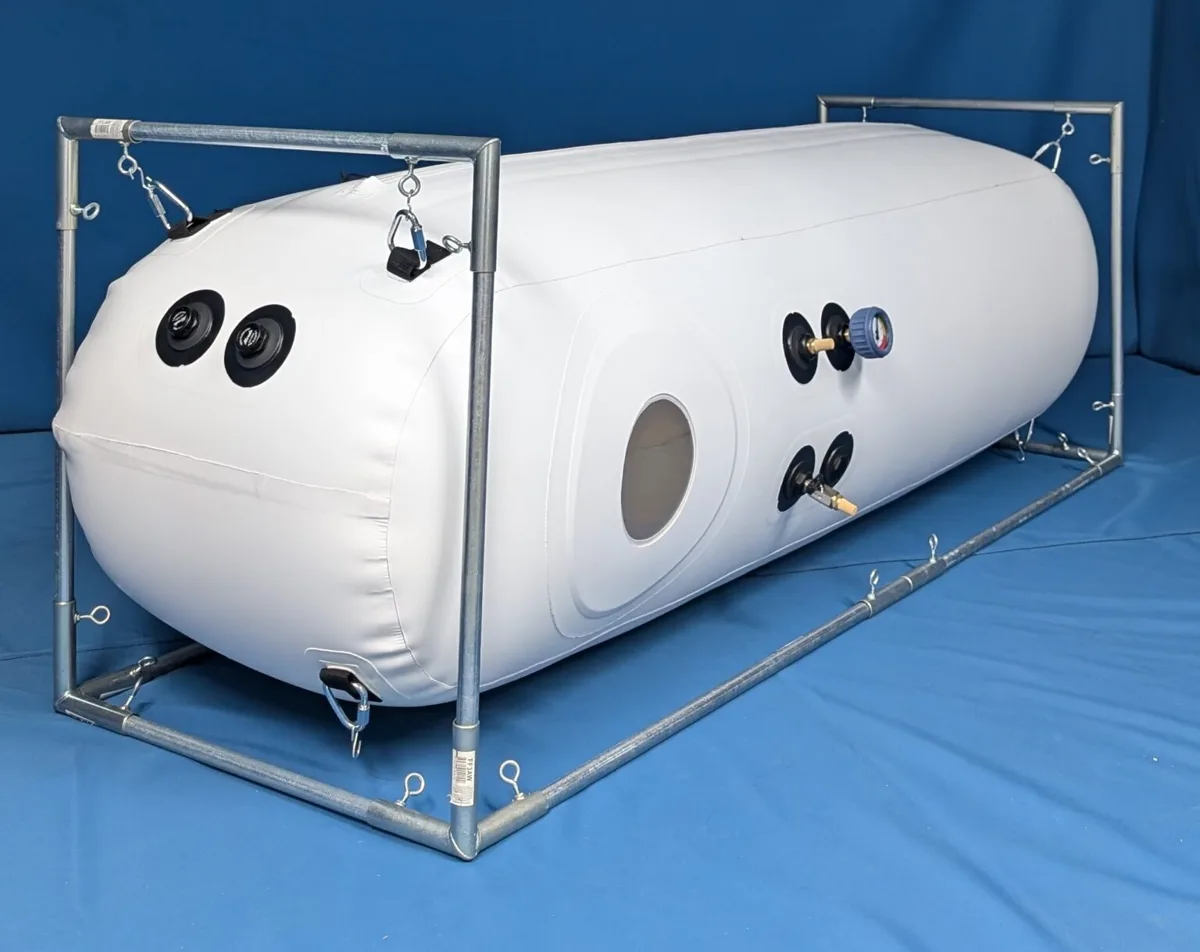
Newtowne A4-27, from $4,095 on sale through November 30, 2026, shipping included. The lowest starting price on this page: a 27 by 84 inch lie-flat chamber at 4 psi on an 80L compressor, with a steel frame of 29.75 by 67.5 inches and one viewport. Newtowne sizes it for an average adult. The 4 inch mattress is a $275 upgrade, so the like-for-like price against chambers that include a mattress is $4,370. Two year warranty.
Newtowne Shoe, $4,895, shipping included. A low profile seated chamber, 68 inches long, 37 wide and 42 tall at pressure, with two viewports and an 80L compressor. Newtowne says people under 5 ft 4 in can also lie down in it. No chair or mat is included. It uses less floor than any lie-flat tube here except the 26 and 27 inch models, by our room math.
Newtowne Long Shoe, $5,495, shipping included. The Shoe's width and height with 81 inches of length, so Newtowne says users up to 6 ft 1 in can sit up or lie down. Same 80L compressor and two viewports, no chair or mat.
Newtowne A4-34, $5,795, shipping included. A 34 by 95 inch lie-flat tube that Newtowne says fits a larger adult or a parent with a young child. The internal gauge and 4 inch mattress are included and its spec lists a 120L compressor as standard. By our math it has the lowest price per cubic foot of any lie-flat tube under 40 inches here, about $116.
Summit to Sea Shallow Dive, from $7,995. Summit to Sea's entry chamber: 26 by 84 inches at 4.4 psi, two redundant compressors with in-line filtration, one viewing window, and a frame, foam mat, bolster cradle and carrying case. Summit to Sea says its double sided full length zippers open from inside or outside. Named in K072757.
Newtowne Tent, $8,195 plus $300 shipping. A walk-in chamber you sit in, 72 by 40 by 58 inches at pressure, on a frame of 62.5 by 64.5 by 60.5 inches, with a 120L compressor. An internal gauge, folding chair and chair mat are included. Delivered, it is $8,495 by our math, the lowest delivered price for a chair style chamber on this page.
Newtowne A4-40, $8,995 plus $400 shipping. Newtowne's largest tube, 40 by 108 inches, which Newtowne says easily fits two adults sitting up or lying down. 120L compressor, internal gauge and mattress included. At about 78.5 cubic feet by our cylinder math, it has the most air space of any lie-flat model here and the lowest price per cubic foot, about $115.
Summit to Sea Dive, from $9,995. Summit to Sea calls it its most popular model: 33 by 90 inches at 4.4 psi, two redundant compressors, two viewing windows, an external frame, foam mat, bolster cradle and carrying case. Named in K072757.
Summit to Sea Dive Vertical, from $13,995. An upright chamber sized for a chair, 40 inches across and 85 inches tall, with a five foot double sided zipper. Summit to Sea says it was the first vertical portable mild hyperbaric chamber on the market and lists US patent 9,622,931. It has an internal frame for faster inflation, an integrated stabilizer, antibacterial carpet and two redundant compressors. By our room math it has the smallest floor footprint on this page, about 11 square feet.
Summit to Sea Grand Dive, from $13,995. A 40 by 90 inch tube that Summit to Sea says has room for two to three people, or for sitting up. About 50 pounds, two redundant compressors, two viewing windows, and frame, foam mat and carrying case included. Named in K072757.
Summit to Sea Grand Dive Vertical, from $17,995. The largest chamber here: 60 inches across and seven feet tall, designed around an easy chair, with a vertical zipper, a floor system with stabilizer, a full frame and three redundant compressors. By our cylinder math it holds about 137 cubic feet of air.
Summit to Sea Grand Dive Pro, from $20,195, or $20,395 with the platform. A 46 inch chamber with a wide entrance and double sided circumferential zippers, about 55 pounds, an external furniture-grade PVC frame and two compressors with in-line filtration. Summit to Sea says it has room for two to three people. The maker does not publish its length on the page we checked, so it is left out of our room and volume math.
What 1.3 ATA means in plain numbers
ATA means atmospheres absolute. Air at sea level presses on you at about 14.7 pounds per square inch, which is 1.0 ATA. A chamber gauge reads the pressure above the room, so a chamber holding 4 psi on the gauge is at about 18.7 psi absolute at sea level, or 1.27 ATA. At 4.4 psi it is 19.1 psi absolute, or 1.30 ATA.
A useful way to picture it is water depth. Seawater adds about 0.445 psi for every foot you descend, so 4 psi equals about 9 feet under the sea and 4.4 psi about 10 feet. That is why your ears feel the pressure change on the way up to pressure, the same way they do at the bottom of a deep pool.
Both makers on this page round to 1.3 ATA. The difference between 4.0 and 4.4 psi is about three hundredths of an atmosphere. It is real, and the table shows it, but it is small next to the effect of where you live.
| Gauge pressure (maker) | Models | Absolute at sea level (our math) | Rounded ATA | Same as seawater depth (our math) | mmHg above ambient (our math) |
|---|---|---|---|---|---|
| 4 psi | A4-27 Mild Hyperbaric Chamber, Shoe Seated Mild Hyperbaric Chamber, Long Shoe Seated Mild Hyperbaric Chamber, A4-34 Mild Hyperbaric Chamber, Tent Walk-In Mild Hyperbaric Chamber, A4-40 Mild Hyperbaric Chamber | 18.70 psi | 1.27 ATA | 9.0 ft | 207 mmHg |
| 4.4 psi | Shallow Dive 26" Mild Hyperbaric Chamber, Dive 33" Mild Hyperbaric Chamber, Dive Vertical Seated Mild Hyperbaric Chamber, Grand Dive 40" Mild Hyperbaric Chamber, Grand Dive Vertical 60" Mild Hyperbaric Chamber, Grand Dive Pro 46" Mild Hyperbaric Chamber | 19.10 psi | 1.30 ATA | 9.9 ft | 228 mmHg |
Our arithmetic on the maker's gauge figure: 1 ATA = 14.696 psi; seawater adds about 0.4445 psi per foot; 1 psi = 51.715 mmHg. Both makers round their figure to 1.3 ATA. Summit to Sea lists its two upright models as 1.3 ATA with a range up to 4.4 psi.
How a soft chamber works, part by part
A soft chamber is a simple system, which is part of why it can run from a household outlet. A compressor draws room air through a filter and pushes it down a hose into the chamber. The chamber's coated fabric walls and zippers hold the air in. Relief valves let air out once the pressure reaches its set point, so fresh air keeps flowing through while the pressure holds steady. A gauge, inside on some models, shows the pressure above the room.
Knowing the parts helps you compare models. Two compressors instead of one means one can stop without the chamber deflating. Zippers that open from inside and outside make getting out easier. An internal gauge lets the person inside see the pressure. A power outage alarm, standard on Newtowne chambers per its 2025 brochure, warns you if the compressor loses power.
| Part | What it does | What the makers here list |
|---|---|---|
| Compressor | Pushes filtered room air into the chamber and makes the pressure | 2 or 3 redundant (Summit to Sea); one 80L or 120L unit (Newtowne) |
| Air filter | Cleans the air going in | In-line filtration on Summit to Sea's lie-flat models |
| Hose | Carries air from compressor to chamber | Summit to Sea notes separate hoses for its two compressors in its FAQ |
| Chamber bladder | Coated fabric shell that holds pressure | 26 to 60 inch diameters on this page |
| Zippers | Seal the entry | Double sided zippers that open from inside or outside (Summit to Sea); 5 ft zipper on the Dive Vertical |
| Relief valves | Vent air to hold the set pressure and keep air moving | Set to 4 psi (Newtowne) or up to 4.4 psi (Summit to Sea) |
| Gauge | Shows pressure above the room | Internal gauge included on Newtowne A4-34, A4-40 and Tent |
| Frame | Holds the shape when deflated and supports the mattress | Steel frames (Newtowne A4 line); external, internal or PVC frames (Summit to Sea) |
| Power outage alarm | Warns if the compressor loses power | Standard on Newtowne, per its 2025 brochure |
From the makers' spec sheets, FAQ and brochure. Ask each maker for the full parts list and replacement costs.
Your elevation changes the pressure inside
This is the number most buying guides skip. A soft chamber's relief valves hold a set pressure above the air outside. At sea level, 4.4 psi above the room is 1.30 ATA absolute. In a city where the outside air is already thinner, the same 4.4 psi sits on top of a lower starting point, so the absolute pressure inside is lower.
The table uses the standard atmosphere formula to show what each maker's stated gauge pressure works out to at common elevations. Las Vegas sits around 2,000 feet; Denver is 5,280 feet. A 1.3 ATA rating at sea level works out to about 1.2 ATA in Las Vegas and about 1.1 ATA in Denver. At 10,000 feet a 4.4 psi chamber only brings you back to about sea level pressure.
| Where the chamber is | Outside air (our math) | Inside at 4.0 psi gauge | Feels like | Inside at 4.4 psi gauge | Feels like |
|---|---|---|---|---|---|
| Sea level | 14.70 psi (1.00 ATA) | 18.70 psi (1.27 ATA) | Like 9.0 ft under seawater | 19.10 psi (1.30 ATA) | Like 9.9 ft under seawater |
| 2,000 ft (Las Vegas area) | 13.66 psi (0.93 ATA) | 17.66 psi (1.20 ATA) | Like 6.7 ft under seawater | 18.06 psi (1.23 ATA) | Like 7.6 ft under seawater |
| 5,280 ft (Denver) | 12.10 psi (0.82 ATA) | 16.10 psi (1.10 ATA) | Like 3.2 ft under seawater | 16.50 psi (1.12 ATA) | Like 4.1 ft under seawater |
| 8,000 ft | 10.92 psi (0.74 ATA) | 14.92 psi (1.01 ATA) | Like 0.5 ft under seawater | 15.32 psi (1.04 ATA) | Like 1.4 ft under seawater |
| 10,000 ft | 10.11 psi (0.69 ATA) | 14.11 psi (0.96 ATA) | Like 1,100 ft altitude | 14.51 psi (0.99 ATA) | Like 400 ft altitude |
| 14,000 ft (high summit) | 8.63 psi (0.59 ATA) | 12.63 psi (0.86 ATA) | Like 4,100 ft altitude | 13.03 psi (0.89 ATA) | Like 3,300 ft altitude |
Our physics math, not maker figures, using the standard atmosphere formula P = 14.696 x (1 - 6.87559e-6 x feet)^5.25588. A soft chamber's relief valve holds a set pressure above the air outside, so the absolute pressure inside drops as the outside air thins. That is why a 1.3 ATA rating at sea level is closer to 1.1 ATA in Denver. Ask your maker how its valves behave at your elevation.
That last row is the reason the original zippered altitude bag exists. The FDA cleared the first portable hyperbaric bag for altitude sickness, the Gamow bag, under 510(k) K874752 on February 2, 1988, and today's mild chambers carry the same kind of clearance. If you live at elevation, ask the maker whether its valves can be set for your altitude and what absolute pressure you should expect.
Inside pressure in 15 US cities
The same chamber does not deliver the same absolute pressure in Miami and in Colorado ski country. The table below applies each maker's stated gauge pressure to the outside air in 15 cities, from the coasts to the Rockies, so you can see what to expect where you live.
In Las Vegas, at about 2,000 feet, a chamber rated 1.3 ATA at sea level works out to about 1.23 ATA. In Denver and Albuquerque it is about 1.12 ATA. Above about 9,000 feet the inside of a mild chamber is close to sea level pressure, which is exactly the job the altitude bag was designed for.
| City | Approximate elevation | Outside air (our math) | Newtowne at 4.0 psi (our math) | Summit to Sea at 4.4 psi (our math) | Lost versus the sea level rating at 4.4 psi |
|---|---|---|---|---|---|
| Miami, New York, Los Angeles (near sea level) | 0 ft | 1.00 ATA | 1.27 ATA | 1.30 ATA | -0% |
| Phoenix, AZ | 1,086 ft | 0.96 ATA | 1.23 ATA | 1.26 ATA | 3% |
| Las Vegas, NV | 2,001 ft | 0.93 ATA | 1.20 ATA | 1.23 ATA | 5% |
| Boise, ID | 2,730 ft | 0.91 ATA | 1.18 ATA | 1.20 ATA | 7% |
| Salt Lake City, UT | 4,226 ft | 0.86 ATA | 1.13 ATA | 1.16 ATA | 11% |
| Reno, NV | 4,506 ft | 0.85 ATA | 1.12 ATA | 1.15 ATA | 12% |
| Denver, CO | 5,280 ft | 0.82 ATA | 1.10 ATA | 1.12 ATA | 14% |
| Albuquerque, NM | 5,312 ft | 0.82 ATA | 1.09 ATA | 1.12 ATA | 14% |
| Colorado Springs, CO | 6,035 ft | 0.80 ATA | 1.07 ATA | 1.10 ATA | 15% |
| Cheyenne, WY | 6,062 ft | 0.80 ATA | 1.07 ATA | 1.10 ATA | 15% |
| Flagstaff, AZ | 6,910 ft | 0.77 ATA | 1.05 ATA | 1.07 ATA | 17% |
| Santa Fe, NM | 7,199 ft | 0.77 ATA | 1.04 ATA | 1.07 ATA | 18% |
| Aspen, CO | 7,908 ft | 0.75 ATA | 1.02 ATA | 1.04 ATA | 20% |
| Breckenridge, CO | 9,600 ft | 0.70 ATA | 0.97 ATA | 1.00 ATA | 23% |
| Leadville, CO | 10,152 ft | 0.68 ATA | 0.96 ATA | 0.98 ATA | 24% |
Our physics math using the standard atmosphere formula and approximate published city elevations; weather changes outside pressure by a few hundredths of an atmosphere from day to day. It assumes the chamber holds the maker's stated gauge pressure above outside air. Ask your maker how its relief valves are set for your elevation.
If you live high and want a particular absolute pressure, raise it with the maker before you order. Do not adjust relief valves yourself; follow the maker's instructions for use.
Oxygen partial pressure: what the physics says
Air is about 20.9 percent oxygen. The pressure of oxygen you breathe, its partial pressure, is the absolute pressure times that fraction. Raising the absolute pressure raises the oxygen partial pressure in proportion, which is the physics behind any hyperbaric chamber.
The table shows the arithmetic for room air, for a mild chamber on air at sea level and in Denver, for an oxygen mask with no chamber, and for the clinical minimum that UHMS sets for its approved uses. We include it so the scale is clear, not to suggest any health effect. The UHMS position statement on low pressure fabric chambers says a mild chamber at under 1.4 ATA on air delivers no more oxygen than a mask at sea level, and that every UHMS approved indication needs near 100 percent oxygen at 2.0 ATA or more.
| Situation | Absolute pressure | Oxygen fraction breathed | Oxygen partial pressure (our math) |
|---|---|---|---|
| Room air at sea level | 1.00 ATA | 21% (air) | 0.209 ATA (159 mmHg) |
| Room air in Denver, outside a chamber | 0.82 ATA | 21% (air) | 0.172 ATA (131 mmHg) |
| Soft chamber at 4.0 psi, sea level, air only | 1.27 ATA | 21% (air) | 0.266 ATA (202 mmHg) |
| Soft chamber at 4.4 psi, sea level, air only | 1.30 ATA | 21% (air) | 0.272 ATA (206 mmHg) |
| Soft chamber at 4.4 psi, Denver, air only | 1.12 ATA | 21% (air) | 0.235 ATA (178 mmHg) |
| Oxygen mask at sea level, no chamber | 1.00 ATA | Up to 100% (prescribed) | Up to 1.000 ATA (760 mmHg) |
| Clinical hard chamber, UHMS minimum for approved uses | 2.00 ATA | Near 100% | About 2.000 ATA (1,520 mmHg) |
Our arithmetic: partial pressure = absolute pressure x oxygen fraction (air is 20.9% oxygen). It describes the gas you breathe, not any health effect. The UHMS position statement says mild chambers at under 1.4 ATA on air deliver no more oxygen than a mask at sea level, and that all UHMS approved indications need near 100% oxygen at 2 ATA or more.
Whether to add supplemental oxygen is a medical and regulatory question, not a shopping one. See the oxygen section below for what the FDA, UHMS and the makers each say.
Is a home hyperbaric chamber FDA cleared?
Hyperbaric chambers are Class II medical devices cleared through the FDA's 510(k) process under product code CBF, according to the FDA's August 2025 letter to health care providers. A 510(k) clearance names an applicant, a device and the models it covers. It is worth reading the actual record rather than relying on a sales page, and anyone can do it free in the FDA's 510(k) database.
We looked up both makers on this page in the FDA's public databases on October 29, 2026. Summit to Sea's clearance, K072757, is in Summit to Sea's own name and names three models. Newtowne's site cites K051759, which the FDA lists under a different applicant; the FDA's registration database lists Typhoon Water Wares, the company behind Newtowne, as marketing a device under that number. Both makers describe their chambers as prescription devices.
| Maker or model on this page | 510(k) the maker cites | FDA applicant of record | Device name in the FDA record | Decision date | What to ask |
|---|---|---|---|---|---|
| Summit to Sea Shallow Dive, Dive, Grand Dive | K072757 | Summit to Sea (registration: Summit to Sea, LLC, Mound, MN) | Dive and Shallow and Grand Dive | February 8, 2008 | Ask for the cleared indications and the instructions for use |
| Summit to Sea Dive Vertical, Grand Dive Vertical, Grand Dive Pro | Maker cites K072757 for its chambers | Summit to Sea | These model names are not in the K072757 device name | Not applicable | Ask Summit to Sea in writing how K072757 covers these models |
| Newtowne A4-27, A4-34, A4-40, Shoe, Long Shoe, Tent | K051759 (Newtowne site footer, with FDA owner operator 10037097) | Performance Hyperbarics, Makawao, HI | Flexi-Lite, Model FL-V1.2 | November 17, 2005 | FDA registration for owner operator 10037097 is Typhoon Water Wares, Pocomoke City, MD, listing product code CBF under K051759. Ask Newtowne which models the clearance covers |
Sources: openFDA 510(k) and registration and listing databases, searched October 29, 2026; Summit to Sea FAQ; Newtowne site footer. We report the records as they read and do not interpret the scope of any clearance. The FDA product code CBF had 69 cleared 510(k)s when we searched.
Read more: FDA 510(k) database
What the FDA has cleared hyperbaric chambers for
The FDA's consumer update, Hyperbaric Oxygen Therapy: Get the Facts, lists 13 disorders for which hyperbaric chambers were cleared as of July 2021. These are clinical treatments that use 100 percent oxygen in a hospital or accredited facility, and the FDA advises going to a facility accredited by UHMS if your provider recommends hyperbaric oxygen therapy.
The same FDA page describes a separate category: a large zippered bag cleared to treat altitude sickness only, which provides pressure but does not attach to oxygen tanks. Summit to Sea's FAQ says its chambers are cleared by the FDA to treat acute altitude sickness. Do not read the clinical list below as uses for a home soft chamber.
| Condition (FDA wording, July 2021) | Setting the FDA describes |
|---|---|
| Air and gas bubbles in blood vessels | Clinical HBOT with 100% oxygen |
| Anemia (severe anemia when blood transfusions cannot be used) | Clinical HBOT with 100% oxygen |
| Burns (severe and large burns treated at a specialized burn center) | Clinical HBOT with 100% oxygen |
| Carbon monoxide poisoning | Clinical HBOT with 100% oxygen |
| Crush injury | Clinical HBOT with 100% oxygen |
| Decompression sickness (diving risk) | Clinical HBOT with 100% oxygen |
| Gas gangrene | Clinical HBOT with 100% oxygen |
| Hearing loss (complete hearing loss that occurs suddenly and without any known cause) | Clinical HBOT with 100% oxygen |
| Infection of the skin and bone (severe) | Clinical HBOT with 100% oxygen |
| Radiation injury | Clinical HBOT with 100% oxygen |
| Skin graft flap at risk of tissue death | Clinical HBOT with 100% oxygen |
| Vision loss (when sudden and painless in one eye due to blockage of blood flow) | Clinical HBOT with 100% oxygen |
| Wounds (non-healing, diabetic foot ulcers) | Clinical HBOT with 100% oxygen |
| Altitude sickness | Zippered bag that provides pressure without oxygen tanks |
Quoted from the FDA consumer update Hyperbaric Oxygen Therapy: Get the Facts, content current as of July 26, 2021 (archived copy). The FDA says it had not cleared or authorized any HBOT device for COVID-19 or any condition beyond those listed.
Read more: FDA: Hyperbaric Oxygen Therapy, Get the Facts (archived)
Claims the FDA says are not proven
Home chamber marketing often reaches well past altitude sickness. The FDA has warned about this twice in consumer updates. In 2013 it published Hyperbaric Oxygen Therapy: Don't Be Misled, listing conditions for which hyperbaric claims had not been cleared. In 2021 it repeated that HBOT devices are not proven to cure cancer, Lyme disease, autism or Alzheimer's disease.
We do not make any of these claims, and you should be cautious of any seller who does. If a page promises a treatment or cure, ask for the FDA clearance that covers that use. The FDA encourages people who experience problems with a hyperbaric device to report them to MedWatch.
| Condition named by the FDA | FDA source |
|---|---|
| Cancer | Get the Facts, 2021 (not proven to cure) |
| Lyme disease | Get the Facts, 2021 (not proven to cure) |
| Autism | Get the Facts, 2021; Don't Be Misled, 2013 |
| Alzheimer's disease | Get the Facts, 2021; Don't Be Misled, 2013 |
| COVID-19 | Get the Facts, 2021 (no device cleared or authorized) |
| AIDS or HIV | Don't Be Misled, 2013 |
| Asthma | Don't Be Misled, 2013 |
| Bell's palsy | Don't Be Misled, 2013 |
| Brain injury | Don't Be Misled, 2013 |
| Cerebral palsy | Don't Be Misled, 2013 |
| Depression | Don't Be Misled, 2013 |
| Heart disease | Don't Be Misled, 2013 |
| Hepatitis | Don't Be Misled, 2013 |
| Migraine | Don't Be Misled, 2013 |
| Multiple sclerosis | Don't Be Misled, 2013 |
| Parkinson's disease | Don't Be Misled, 2013 |
| Spinal cord injury | Don't Be Misled, 2013 |
| Sports injury | Don't Be Misled, 2013 |
| Stroke | Don't Be Misled, 2013 |
From the FDA consumer updates Hyperbaric Oxygen Therapy: Don't Be Misled (August 2013, archived) and Get the Facts (July 2021, archived). Research continues on many conditions; this table reports only what the FDA has said about clearance.
Read more: FDA: Don't Be Misled, 2013 (archived)
Risks the FDA and UHMS name
The FDA lists the risks of hyperbaric oxygen therapy as ear and sinus pain, middle ear injuries including tympanic membrane rupture, temporary vision changes, lung collapse (rare), and fire from high oxygen concentrations. It also says it is aware of people using zippered altitude bags to create homemade HBOT devices, which can pose a risk of fire and suffocation.
Ear pressure is the one almost every first time user notices. As the chamber fills, the air in your middle ear needs to equalize, the same as on a descending airplane. Makers teach equalizing techniques and slow fill rates. Anyone with ear, sinus or lung conditions, anyone who is pregnant, and anyone taking medication should talk with a physician before using a chamber.
| Risk | Source | What the source says to do |
|---|---|---|
| Ear and sinus pain | FDA, Get the Facts | Check with a health care provider first |
| Middle ear injury, including eardrum rupture | FDA, Get the Facts | Check with a health care provider first |
| Temporary vision changes | FDA, Get the Facts | Check with a health care provider first |
| Lung collapse (rare) | FDA, Get the Facts | Check with a health care provider first |
| Fire | FDA, Get the Facts; FDA letter, August 2025 | Follow fire prevention measures and the maker's instructions; high oxygen concentration raises fire risk |
| Fire and suffocation from homemade oxygen setups in altitude bags | FDA, Get the Facts | Do not modify a chamber or add oxygen outside the maker's and physician's instructions |
| Serious injuries and deaths reported with HBOT devices | FDA letter, August 2025 | Follow the instructions for use, grounding, supervision and maintenance; root cause of recent fires not known |
Quoted or closely paraphrased from the FDA sources linked on this page. Not a complete list; your physician and the maker's instructions for use come first.
Fire safety: what the FDA told providers in August 2025
On August 25, 2025 the FDA sent a letter to health care providers and facilities titled Follow Instructions for Safe Use of Hyperbaric Oxygen Therapy Devices. It says the FDA is aware of reports of fires with HBOT devices that resulted in serious injuries and deaths, that the root cause is not known, and that serious adverse events are rare but do occur. The letter is written for clinics, but every item on it applies just as well at home.
| FDA recommendation (August 25, 2025) | What it means at home |
|---|---|
| Review and follow the manufacturer's instructions for use | Read the whole manual before the first session and keep it near the chamber |
| Ensure fire prevention and safety measures are followed | No heaters, candles, smoking or open flame in the room; keep a clear exit path |
| Be aware of heightened fire risk with oxygen at high concentration | Use oxygen only as the maker and your physician direct |
| Ensure proper grounding equipment is used | Ask the maker what grounding it specifies |
| Ensure proper training is provided and maintained | Have the maker walk you through setup, pressurizing and emergency exit |
| Ensure the patient is monitored and supervised for the whole treatment | Do not use the chamber alone; have someone nearby who can open it |
| Follow recommended cleaning, maintenance intervals and safety checks | Log filter changes, zipper care and valve checks |
| Avoid prohibited items, including electrical or static devices | Leave phones, chargers and battery devices out unless the maker approves them |
| Wear clothing of hyperbaric compatible materials, such as cotton | Wool and synthetic fabrics can make more static electricity |
Left column quoted or closely paraphrased from the FDA letter. Right column is our plain language reading; your maker's manual takes priority.
Read more: FDA letter, August 25, 2025
NFPA 99, ASME PVHO-1 and local fire codes
Two standards come up in every serious conversation about hyperbaric safety. NFPA 99, the Health Care Facilities Code, has a chapter on hyperbaric facilities, Chapter 14. ASME PVHO-1 is the safety standard for pressure vessels for human occupancy. The FDA's August 2025 letter lists both, NFPA 99 2024 edition and ASME PVHO-1 2023 edition, as additional resources.
Whether a fire marshal treats a home chamber as covered depends on your state and city. Minnesota's State Fire Marshal has published an interpretation that mild hyperbaric oxygen therapy chambers, which it describes as typically running at 2 to 4.5 psi with oxygen given by mask or cannula, fall under its fire code section 609, so the chambers and the facilities housing them must comply with NFPA 99 Chapter 14. That interpretation was written about facilities, but it shows how fire officials view these chambers.
| Standard or rule | What it covers | Source |
|---|---|---|
| NFPA 99, Chapter 14 | Hyperbaric facilities: construction, equipment, fire protection, operation and maintenance | FDA letter, August 2025; Minnesota State Fire Marshal interpretation |
| NFPA 99 chamber classes | Class A human multiple occupancy, Class B human single occupancy, Class C animal | NFPA 99 as cited in the Minnesota State Fire Marshal interpretation |
| ASME PVHO-1 | Safety standard for pressure vessels for human occupancy | FDA letter, August 2025; UHMS position statement |
| Minnesota State Fire Code section 609 | Hyperbaric facilities inspected, tested and maintained per NFPA 99 (2012 edition) | Minnesota State Fire Marshal interpretation |
| Minnesota Building Code section 425.1 | Adopts NFPA 99 Chapter 14 (2012 edition) for hyperbaric facilities | Minnesota State Fire Marshal interpretation |
| Your local fire and building department | Whether any permit or rule applies to a chamber in a home | Call before you buy if you rent, live in a condo or plan new wiring |
We summarize the scope of each standard as the cited sources describe it. Ask the maker which standards its chamber was built and tested to.
Read more: Minnesota State Fire Marshal: mild hyperbaric oxygen therapy · UHMS position statement on low pressure fabric chambers
Soft chamber or hard shell
A soft chamber is a coated fabric bladder that inflates on a frame and runs at about 1.3 ATA. A hard shell is a rigid steel or acrylic vessel that can run at higher pressures, weighs far more and stays in one room. Every chamber on this page is a soft chamber.
UHMS draws the line sharply. Its position statement says low pressure fabric chambers under 1.4 ATA are cleared for acute mountain sickness only and are designed for air, that ASME PVHO-1 applies to vessels above 2 psig, and that UHMS does not recommend mild hyperbaric therapy for any medical purpose other than acute mountain sickness and does not endorse in-home therapy. UHMS has also warned consumers that many soft chambers on the market are not FDA registered or PVHO-1 certified.
| Soft mild chamber (this page) | Hard shell chamber | |
|---|---|---|
| Pressure | About 1.3 ATA (4 to 4.4 psi gauge at the makers here) | Commonly 1.5 to 2.0 ATA or more |
| Build | Coated fabric bladder, zipper entry, frame inside or outside | Steel or acrylic vessel with a door or hatch |
| Weight | About 50 to 55 lb for the two Summit to Sea models that list it | Hundreds of pounds or more; check floor loading |
| Power | Compressor on a standard 120 volt outlet | Varies; ask for the nameplate rating |
| FDA clearance on this page | K072757 (Summit to Sea); K051759 cited by Newtowne | Varies by maker; search product code CBF |
| UHMS view | Cleared for acute mountain sickness; not recommended for other medical purposes; in-home therapy not endorsed | UHMS approved indications need at least 2.0 ATA with near 100% oxygen, in an accredited facility |
| Prices on this page | $4,095 to $20,195 starting prices | Not sold on this page |
Soft chamber figures from our catalog; UHMS view from its position statement on low pressure fabric chambers.
Read more: Soft vs hard chamber guide
Oxygen concentrators and chamber compressors are different machines
Every soft chamber here is pressurized by an air compressor that pushes filtered room air into the chamber and out through relief valves. It is the compressor that makes the pressure. An oxygen concentrator is a separate machine that pulls nitrogen out of room air to deliver a higher oxygen concentration through a mask or cannula. It does not pressurize anything.
The rules differ too. The FDA has said oxygen concentrators are prescription devices. Its consumer update says the zippered bags it cleared for altitude sickness are not cleared for use with oxygen tanks or oxygen concentrators, and UHMS says these chambers are designed for air only. Newtowne sells a 10 liter oxygen concentrator for $1,575 including shipping, says a prescription is required for it, and says every chamber includes an oxygen kit. If you are considering oxygen, ask the maker in writing how its FDA clearance covers it, and follow your physician.
| Chamber air compressor | Oxygen concentrator | |
|---|---|---|
| Job | Fills the chamber with filtered room air and holds pressure | Raises oxygen concentration delivered to a mask or cannula |
| Makes pressure? | Yes | No |
| Included with the chambers here? | Yes: 2 or 3 redundant compressors (Summit to Sea); one 80L or 120L unit (Newtowne) | No; Newtowne sells one separately for $1,575 including shipping |
| Prescription | Both makers say their chambers require a prescription | FDA: prescription device; Newtowne: prescription required |
| FDA view on use with altitude bags | Pressure from air is the cleared design | Zippered altitude bags not cleared for use with oxygen tanks or concentrators |
| Fire risk | Room air | Higher oxygen raises fire risk (FDA, August 2025) |
Sources: maker product pages and FAQs; FDA consumer updates on HBOT and on oxygen concentrators; FDA letter of August 2025; UHMS position statement.
How much room a home chamber really needs
Measure the size at pressure, not the box. Then add room to get in and out and room for the compressor. We use a planning allowance of 36 inches at the entry end and 24 inches along one side for the compressor and hoses. That is our figure, not a maker requirement, so check your maker's manual.
Upright models need ceiling height as well as floor. The Dive Vertical stands 85 inches tall at pressure and the Grand Dive Vertical seven feet, so they fit under a standard 8 foot ceiling but not under a low basement soffit. Newtowne's Tent is 58 inches tall with a 60.5 inch frame.
| Model | Chamber footprint (maker size) | Frame (maker) | Floor area of chamber (our math) | Room to plan with 3 ft entry + 2 ft side (our math) | Height at pressure | Fits under an 8 ft ceiling? |
|---|---|---|---|---|---|---|
| A4-27 Mild Hyperbaric Chamber | 27" x 84" | Steel, 29.75" x 67.5" | 17.4 sq ft | 10.0 x 4.5 ft (45 sq ft) | 27" | Yes |
| Shoe Seated Mild Hyperbaric Chamber | 68" x 37" | 64.5" x 27.75" x 42" high at head end | 17.5 sq ft | 8.7 x 5.1 ft (44 sq ft) | 42" | Yes |
| Long Shoe Seated Mild Hyperbaric Chamber | 81" x 37" | 68" x 27.75" x 42" high at head end | 20.8 sq ft | 9.8 x 5.1 ft (50 sq ft) | 42" | Yes |
| A4-34 Mild Hyperbaric Chamber | 34" x 95" | Steel, 36.75" x 77.5" | 24.2 sq ft | 10.9 x 5.1 ft (55 sq ft) | 34" | Yes |
| Shallow Dive 26" Mild Hyperbaric Chamber | 26" x 84" | - | 15.2 sq ft | 10.0 x 4.2 ft (42 sq ft) | 26" | Yes |
| Tent Walk-In Mild Hyperbaric Chamber | 72" x 40" | 62.5" x 64.5" x 60.5" tall | 31.3 sq ft | 9.0 x 7.2 ft (65 sq ft) | 60.5" | Yes |
| A4-40 Mild Hyperbaric Chamber | 40" x 108" | Steel, 41.75" x 88.5" | 31.3 sq ft | 12.0 x 5.5 ft (66 sq ft) | 40" | Yes |
| Dive 33" Mild Hyperbaric Chamber | 33" x 90" | - | 20.6 sq ft | 10.5 x 4.8 ft (50 sq ft) | 33" | Yes |
| Dive Vertical Seated Mild Hyperbaric Chamber | 40" round | - | 11.1 sq ft | 6.3 x 5.3 ft (34 sq ft) | 85" | Yes |
| Grand Dive 40" Mild Hyperbaric Chamber | 40" x 90" | - | 25.0 sq ft | 10.5 x 5.3 ft (56 sq ft) | 40" | Yes |
| Grand Dive Vertical 60" Mild Hyperbaric Chamber | 60" round | - | 25.0 sq ft | 8.0 x 7.0 ft (56 sq ft) | 84" | Yes |
Our planning math, not a maker requirement: the maker's size at pressure (or frame, if larger) plus 36 inches at the entry end to climb in and out and 24 inches along one side for the compressor and hoses. The ceiling check allows 6 inches above the chamber in a 96 inch room. Upright models need the full height; lie-flat tubes need only their diameter.
Grand Dive Pro is left out because Summit to Sea does not publish its length on the page we checked. Pick a level floor in a cooled interior room, keep the zipper side clear, and put the compressor where you can hear its alarm.
Air volume and price per cubic foot
Diameter is the number makers advertise, but the air space you sit or lie in grows with the square of the diameter. A 40 inch tube holds more than twice the air of a 27 inch tube of similar length. The table works out each chamber's air space as a plain cylinder from its stated size at pressure.
| Model | Shape | Inside size (maker) | Air space as a cylinder (our math) | Liters (our math) | Price per cubic foot (our math) |
|---|---|---|---|---|---|
| Shallow Dive 26" Mild Hyperbaric Chamber | Lie-flat tube | 26" diameter x 84" long | 25.8 cu ft | 731 | $310 |
| A4-27 Mild Hyperbaric Chamber | Lie-flat tube | 27" diameter x 84" long | 27.8 cu ft | 788 | $147 |
| Dive 33" Mild Hyperbaric Chamber | Lie-flat tube | 33" diameter x 90" long | 44.5 cu ft | 1,261 | $224 |
| A4-34 Mild Hyperbaric Chamber | Lie-flat tube | 34" diameter x 95" long | 49.9 cu ft | 1,413 | $116 |
| Dive Vertical Seated Mild Hyperbaric Chamber | Upright cylinder | 40" diameter x 85" tall | 61.8 cu ft | 1,750 | $226 |
| Grand Dive 40" Mild Hyperbaric Chamber | Lie-flat tube | 40" diameter x 90" long | 65.4 cu ft | 1,853 | $214 |
| A4-40 Mild Hyperbaric Chamber | Lie-flat tube | 40" diameter x 108" long | 78.5 cu ft | 2,224 | $115 |
| Grand Dive Vertical 60" Mild Hyperbaric Chamber | Upright cylinder | 60" diameter x 7 ft tall | 137.4 cu ft | 3,892 | $131 |
Our math: pi x (diameter / 2) squared x length, treating each chamber as a plain cylinder at its stated size at pressure. Real air space is a little smaller because of the ends, mattress and frame. Models without a published diameter and length (Grand Dive Pro, and Newtowne's box-shaped Shoe, Long Shoe and Tent) are left out rather than guessed.
Price per cubic foot is not a quality score; it shows where you pay for room and where you pay for features such as redundant compressors and upright frames. Bigger chambers also take longer to fill, so ask the maker for its fill time at your elevation.
Compressors and redundancy
The compressor is the heart of a soft chamber. If it stops, the chamber slowly loses pressure through its relief valves. Summit to Sea builds every model with at least two redundant compressors, three on the Grand Dive Vertical, and lists in-line air filtration on its lie-flat models. Newtowne lists a single 80L or 120L compressor per model, its name for the unit size, and its 2025 brochure lists a power outage alarm as standard.
| Compressor setup (maker) | Models | From | Makers |
|---|---|---|---|
| 80L | A4-27 Mild Hyperbaric Chamber, Shoe Seated Mild Hyperbaric Chamber, Long Shoe Seated Mild Hyperbaric Chamber | $4,095 | Newtowne Hyperbarics |
| 120L standard (80L on military version) | A4-34 Mild Hyperbaric Chamber | $5,795 | Newtowne Hyperbarics |
| 2 redundant, in-line air filtration | Shallow Dive 26" Mild Hyperbaric Chamber, Dive 33" Mild Hyperbaric Chamber, Grand Dive 40" Mild Hyperbaric Chamber, Grand Dive Pro 46" Mild Hyperbaric Chamber | $7,995 | Summit to Sea |
| 120L | Tent Walk-In Mild Hyperbaric Chamber, A4-40 Mild Hyperbaric Chamber | $8,195 | Newtowne Hyperbarics |
| 2 redundant | Dive Vertical Seated Mild Hyperbaric Chamber | $13,995 | Summit to Sea |
| 3 redundant | Grand Dive Vertical 60" Mild Hyperbaric Chamber | $17,995 | Summit to Sea |
Quoted from each maker. Summit to Sea runs two or three redundant compressors on every model; Newtowne lists an 80L or 120L compressor per model (its name for the unit size) and, in its 2025 brochure, a power outage alarm as standard.
Ask any maker how loud the compressor is, how long its filters last, what the replacement cost is, and how long the chamber holds pressure after a power cut.
What comes in the box
Inclusions change the real price more than buyers expect. Newtowne's A4-27 is the lowest starting price on this page, but its 4 inch mattress is a $275 upgrade, while the A4-34 and A4-40 include a mattress and an internal gauge. The Shoe and Long Shoe include no chair or mat. Summit to Sea's lie-flat models list a foam mat, bolster cradle and carrying case.
| Model | Mattress or mat | Chair | Gauge | Frame (maker) | Carrying case | Windows or viewports |
|---|---|---|---|---|---|---|
| A4-27 Mild Hyperbaric Chamber | Upgrade | - | - | Steel, 29.75" x 67.5" | - | 1 viewport |
| Shoe Seated Mild Hyperbaric Chamber | No | No | - | 64.5" x 27.75" x 42" high at head end | - | 2 viewports |
| Long Shoe Seated Mild Hyperbaric Chamber | No | No | - | 68" x 27.75" x 42" high at head end | - | 2 viewports |
| A4-34 Mild Hyperbaric Chamber | Yes | - | Internal gauge | Steel, 36.75" x 77.5" | - | 2 viewports |
| Shallow Dive 26" Mild Hyperbaric Chamber | Yes | - | - | Frame | Yes | 1 viewing window |
| Tent Walk-In Mild Hyperbaric Chamber | - | Yes | Internal gauge | 62.5" x 64.5" x 60.5" tall | - | 2 viewports |
| A4-40 Mild Hyperbaric Chamber | Yes | - | Internal gauge | Steel, 41.75" x 88.5" | - | 2 viewports |
| Dive 33" Mild Hyperbaric Chamber | Yes | - | - | External frame | Yes | 2 viewing windows |
| Dive Vertical Seated Mild Hyperbaric Chamber | - | - | - | Internal frame (maker text) | - | - |
| Grand Dive 40" Mild Hyperbaric Chamber | Yes | - | - | Frame | Yes | 2 viewing windows |
| Grand Dive Vertical 60" Mild Hyperbaric Chamber | - | - | - | Full frame (maker text) | - | - |
| Grand Dive Pro 46" Mild Hyperbaric Chamber | - | - | - | External furniture-grade PVC | - | - |
Read from the "Included", "Frame" and "Windows" lines of each maker spec, or, where a model has no Included line, from the maker sentence that says what is included (Grand Dive) or describes the frame (Dive Vertical, Grand Dive Vertical). A dash means the maker does not list that item for the model on the page we checked, not that it is missing. Upgrade means the maker sells it as an add-on.
Delivered price and what you actually pay
Newtowne includes shipping on its A4-27, Shoe, Long Shoe and A4-34, and charges $300 for the Tent and $400 for the A4-40. Summit to Sea does not list shipping on the model pages we checked. Newtowne's prices are fall sale prices that it lists through November 30, 2026.
| Model | Maker | From | Shipping (maker) | Delivered price before tax (our math) | Price per inch of diameter (our math) |
|---|---|---|---|---|---|
| A4-27 Mild Hyperbaric Chamber | Newtowne Hyperbarics | $4,095 | Included (maker) | $4,095 | $152 |
| Shoe Seated Mild Hyperbaric Chamber | Newtowne Hyperbarics | $4,895 | Included (maker) | $4,895 | $132 |
| Long Shoe Seated Mild Hyperbaric Chamber | Newtowne Hyperbarics | $5,495 | Included (maker) | $5,495 | $149 |
| A4-34 Mild Hyperbaric Chamber | Newtowne Hyperbarics | $5,795 | Included (maker) | $5,795 | $170 |
| Shallow Dive 26" Mild Hyperbaric Chamber | Summit to Sea | $7,995 | Not stated on the page we checked | Ask the maker | $308 |
| Tent Walk-In Mild Hyperbaric Chamber | Newtowne Hyperbarics | $8,195 | $300 (maker) | $8,495 | $205 |
| A4-40 Mild Hyperbaric Chamber | Newtowne Hyperbarics | $8,995 | $400 (maker) | $9,395 | $225 |
| Dive 33" Mild Hyperbaric Chamber | Summit to Sea | $9,995 | Not stated on the page we checked | Ask the maker | $303 |
| Dive Vertical Seated Mild Hyperbaric Chamber | Summit to Sea | $13,995 | Not stated on the page we checked | Ask the maker | $350 |
| Grand Dive 40" Mild Hyperbaric Chamber | Summit to Sea | $13,995 | Not stated on the page we checked | Ask the maker | $350 |
| Grand Dive Vertical 60" Mild Hyperbaric Chamber | Summit to Sea | $17,995 | Not stated on the page we checked | Ask the maker | $300 |
| Grand Dive Pro 46" Mild Hyperbaric Chamber | Summit to Sea | $20,195 | Not stated on the page we checked | Ask the maker | $439 |
Our math adds the maker's stated shipping to its starting price. Newtowne's prices are fall sale prices that it lists through November 30, 2026. Diameter uses the stated diameter, or the stated width for box-shaped models.
Beyond the delivered price, plan for a physician visit for the prescription both makers require, any accessories your physician recommends, an electrician if you need a new outlet, and replacement filters.
Electrical: one outlet, nothing else on it
Every chamber here runs from a standard 120 volt outlet. Summit to Sea specifies a 120 volt 15 amp outlet for every model; Newtowne says a standard 120 volt household outlet. Neither maker lists compressor wattage on the model pages we checked, so ask for the nameplate rating, especially if you will also run an air conditioner, a concentrator or a fan in the same room.
Under the National Electrical Code, a load that runs for three hours or more is continuous, and the circuit is sized at 125 percent of it, so a 15 amp circuit carries 12 amps continuously. A long chamber session plus a window air conditioner or space heater on the same circuit can trip the breaker and stop the compressor.
| Item | Figure | Source |
|---|---|---|
| Outlet the makers specify | Standard 120 V (Newtowne); 120 V 15 A (Summit to Sea) | Maker spec sheets |
| 15 A circuit, nominal | 1,800 W (15 A x 120 V) | Our arithmetic |
| 15 A circuit, continuous load limit | 12 A, about 1,440 W | NEC continuous load rule (125 percent sizing) |
| 20 A circuit, continuous load limit | 16 A, about 1,920 W | NEC continuous load rule (125 percent sizing) |
| Compressor nameplate watts | Ask the maker | Not on the model pages we checked |
| Extension cords | Avoid unless the maker approves one in writing | Maker manuals; NEC 400.12 bars cords as a substitute for fixed wiring |
| New outlet or circuit | Licensed electrician and a local permit where required | Your local building department |
Planning figures only. Your maker's manual and a licensed electrician have the final word.
Prescriptions and who you buy from
Summit to Sea's FAQ says all of its chambers require a prescription. Newtowne's site says mild hyperbaric chambers are considered a Class II medical device by the FDA and require a prescription. Plan the physician conversation first, because the maker will ask for it before shipping.
We send you to the maker's own page to buy. Each maker sets its own price, prescription process, delivery, warranty and returns, and Summit to Sea lists its chamber line as in production since 2007, while Newtowne says Typhoon Water Wares has built chambers since 2001.
| Maker | Based in | Prescription | Warranty | Shipping | FDA reference |
|---|---|---|---|---|---|
| Summit to Sea | Mound, Minnesota | Required for all chambers (maker FAQ) | On the maker's warranty page | Ask the maker | K072757 |
| Newtowne Hyperbarics (Typhoon Water Wares) | Pocomoke City, Maryland | Required (maker site) | 2 years (maker) | Included on four models; $300 Tent; $400 A4-40 | Cites K051759; FDA owner operator 10037097 |
From each maker's site and the FDA databases, checked October 26 to 29, 2026.
Read more: Summit to Sea · Newtowne Hyperbarics
A short history of the portable chamber
The portable soft chamber started as a mountaineering tool. The FDA cleared the Gamow Hyperbaric Bag under 510(k) K874752 on February 2, 1988, a zippered bag a climber could be sealed inside and pumped up to simulate a lower altitude. The FDA still describes this kind of zippered bag as cleared to treat altitude sickness only.
Home mild chambers grew out of that design. Performance Hyperbarics' Flexi-Lite, Model FL-V1.2, was cleared under K051759 on November 17, 2005; that is the number Newtowne cites today. Summit to Sea's Dive, Shallow Dive and Grand Dive were cleared together under K072757 on February 8, 2008, and Summit to Sea says its current product line has been in production since 2007. When we searched, the FDA's hyperbaric product code, CBF, had 69 cleared 510(k)s in all, from clinical hard chambers to soft bags.
| Date | Event | Source |
|---|---|---|
| February 2, 1988 | Gamow Hyperbaric Bag cleared, K874752 | openFDA 510(k) database |
| November 17, 2005 | Flexi-Lite, Model FL-V1.2 (Performance Hyperbarics) cleared, K051759 | openFDA 510(k) database |
| 2007 | Summit to Sea's current product line enters production | Summit to Sea FAQ |
| February 8, 2008 | Summit to Sea Dive, Shallow Dive and Grand Dive cleared, K072757 | openFDA 510(k) database |
| August 2013 | FDA consumer update warns about unproven hyperbaric claims | FDA, Don't Be Misled (archived) |
| July 2021 | FDA consumer update lists 13 cleared conditions and the altitude bag | FDA, Get the Facts (archived) |
| August 25, 2025 | FDA letter to providers on safe use and fire risk | FDA letter to health care providers |
Dates from the sources listed.
Questions to ask a maker before you order
A good maker answers all of these in writing. Save the answers with your order confirmation.
| Question | Why it matters |
|---|---|
| Which 510(k) covers this exact model, and what use is it cleared for? | Clearances name specific devices and uses |
| Can I see the instructions for use before I buy? | The FDA tells providers to follow them for every session |
| What prescription do you need, and who reviews it? | Both makers here require one |
| What absolute pressure will I get at my elevation? | Relief valves hold pressure above the room, not absolute |
| What is the compressor's nameplate wattage and noise level? | Circuit planning and comfort |
| How long does the chamber hold pressure if the power fails, and is there an alarm? | Safe exit and peace of mind |
| How do I open the zipper from inside, and can someone open it from outside? | Emergency exit |
| What standards was this chamber built and tested to? | UHMS warns that many soft chambers are not PVHO-1 certified |
| What are the warranty terms for the bladder, zipper and compressor? | These wear at different rates |
| What does shipping cost, and is a mattress, gauge or chair included? | Delivered price |
| What filters and parts need replacing, how often, and at what cost? | Running cost |
| What is your policy on supplemental oxygen with this chamber? | FDA and UHMS limits on oxygen in altitude bags |
Our checklist, built from the FDA and UHMS sources on this page.
Common buying mistakes
These are the mistakes that show up again and again in questions from chamber shoppers. Every one is avoidable with a tape measure, a phone call and a look at the FDA database.
| Mistake | What to do instead |
|---|---|
| Measuring the box instead of the inflated chamber | Use the size at pressure plus entry and compressor clearance |
| Forgetting the ceiling for an upright model | Check 85 inches (Dive Vertical) or 7 ft (Grand Dive Vertical) plus headroom |
| Comparing starting prices without inclusions | Add the mattress, chair, gauge and shipping the model lacks |
| Assuming every chamber has the same FDA clearance | Look up the K number and the models it names |
| Believing treatment claims on a sales page | Check the FDA's cleared list and its warnings on unproven claims |
| Adding oxygen without the maker's and physician's say | Ask the maker in writing and follow your physician; FDA and UHMS set limits |
| Sharing the circuit with a heater or air conditioner | Use a dedicated 120 V outlet; a 15 A circuit carries 12 A continuously |
| Putting the chamber in a hot garage | Choose a cooled interior room |
| Ignoring elevation | Ask what absolute pressure you will get where you live |
| Using the chamber alone | Have someone nearby who can open it, as the FDA advises for supervision |
Our list, drawn from the tables and sources on this page.
Budget bands
Starting prices on this page run from $4,095 to $20,195. The bands below show what each budget buys. Most buyers with a single adult user and a standard room land in the first three bands.
| Starting price | Models | Which ones | Styles in this band |
|---|---|---|---|
| Under $5,000 | 2 | A4-27, Shoe Seated | Lie flat; Sit up inside (low profile) |
| $5,000 to $7,999 | 3 | Long Shoe Seated, A4-34, Shallow Dive 26" | Sit up inside (low profile); Lie flat |
| $8,000 to $11,999 | 3 | Tent Walk-In, A4-40, Dive 33" | Walk in, sit in a chair; Lie flat |
| $12,000 to $17,999 | 3 | Dive Vertical Seated, Grand Dive 40", Grand Dive Vertical 60" | Upright, sit in a chair; Lie flat |
| $18,000 and up | 1 | Grand Dive Pro 46" | Lie flat |
Starting price is the maker's lowest listed price as last checked. Prescription, an oxygen concentrator where prescribed, a cooler, a dedicated outlet and shipping can add to it.
Read more: Home hyperbaric chamber cost in 2026
Setting up a home chamber safely
Choose a cooled interior room with a level floor and a steady temperature. The compressor feeds the chamber with room air, so a hot garage means a hot session; in Las Vegas and other desert cities, summer garages regularly pass 100 F. Keep the chamber out of direct sun and away from heaters.
Keep the zipper side and the path to the door clear. Run the compressor hose and power cord where nobody will trip on them. Keep phones, chargers, battery devices and anything that can spark out of the chamber unless the maker approves them, wear cotton clothing as the FDA letter describes, and never use the chamber with nobody nearby. Follow the maker's cleaning and inspection schedule for zippers, seals, valves and filters.
Dry air builds static electricity. Desert homes, winter heating and synthetic fabrics all make it worse, which is one reason the FDA letter mentions clothing materials and grounding. Ask the maker what it recommends for your climate.
| Step | What to do | Why |
|---|---|---|
| Room | Interior, cooled, level floor, door that opens easily | Comfort and a clear exit |
| Clearance | About 3 ft at the entry, 2 ft for the compressor (our planning figures) | Getting in and out, airflow to the compressor |
| Outlet | Dedicated 120 V outlet, nothing large on the same circuit | Avoid tripping the breaker mid session |
| Items inside | No phones, chargers, battery devices or heat sources unless the maker approves | FDA letter: avoid electrical or static devices |
| Clothing | Cotton or as the maker specifies | FDA letter: wool and synthetics make more static |
| Supervision | Someone nearby who knows how to open the chamber | FDA letter: monitor and supervise |
| Maintenance | Follow the maker's schedule for filters, zippers, seals and valves | FDA letter: follow cleaning and maintenance intervals |
Our setup checklist, based on the FDA letter of August 2025 and the makers' published guidance.
Notes for Las Vegas, Henderson and desert homes
Plugging a chamber into an existing outlet is not new wiring. Adding a receptacle or circuit is, and in Southern Nevada that work goes through your local building department: the City of Las Vegas, Henderson, North Las Vegas, or Clark County for unincorporated areas such as Spring Valley, Enterprise and Paradise. Hire a Nevada licensed electrician for new wiring.
Heat is the bigger local issue. Summer afternoons in the Las Vegas Valley often pass 105 F, and garages and casitas without cooling run hotter. The compressor pushes room air into the chamber, so a hot room means a hot session. Plan on an air conditioned interior room, keep the compressor out of direct sun, and follow the maker's operating temperature guidance. Dry desert air also builds static, which matters given the FDA's guidance on clothing and static devices.
Elevation matters a little here too. At about 2,000 feet, a chamber rated 1.3 ATA at sea level works out to about 1.23 ATA by our math. Henderson and Summerlin sit a few hundred feet higher than the Strip, which lowers it slightly more.
Hyperbaric terms in plain English
Chamber pages use a lot of shorthand. This glossary covers every term on this page.
| Term | Meaning |
|---|---|
| ATA | Atmospheres absolute. Sea level air is 1.0 ATA, about 14.7 psi. |
| psi (gauge) | Pounds per square inch above the surrounding air, which is what a chamber gauge reads. |
| psi (absolute) | Total pressure including the air outside: gauge psi plus outside air pressure. |
| Mild hyperbaric chamber | A soft chamber running below about 1.4 ATA, usually 1.3 ATA at sea level. |
| Soft chamber | A coated fabric bladder on a frame, filled by an air compressor, closed with zippers. |
| Hard shell | A rigid steel or acrylic pressure vessel that can run at higher pressures. |
| 510(k) | The FDA premarket clearance for most Class II medical devices; each has a K number. |
| Product code CBF | The FDA product code for hyperbaric chambers, used to search the 510(k) database. |
| Class II device | An FDA risk class for medical devices that usually need 510(k) clearance. |
| Owner operator number | The FDA registration number for a company that makes or markets devices. |
| Acute mountain sickness (AMS) | Altitude sickness; the use soft chambers are cleared for, per UHMS and Summit to Sea. |
| UHMS | Undersea and Hyperbaric Medical Society, which accredits hyperbaric facilities and publishes position statements. |
| NFPA 99 | The Health Care Facilities Code; Chapter 14 covers hyperbaric facilities. |
| ASME PVHO-1 | Safety standard for pressure vessels for human occupancy. |
| Relief valve | A valve that lets air out to hold the chamber at its set pressure. |
| Redundant compressors | Two or more compressors, so one can fail without the chamber losing pressure. |
| Oxygen concentrator | A prescription machine that delivers a higher oxygen concentration through a mask or cannula; it does not make pressure. |
| Oxygen partial pressure | Absolute pressure times the oxygen fraction of the gas you breathe. |
| Equalizing | Opening the ear passages so middle ear pressure matches the chamber, as on a descending flight. |
| Viewport or viewing window | A clear panel in the chamber wall. |
| Bolster cradle | Summit to Sea's term for the support that holds a lie-flat chamber steady on the floor. |
| Instructions for use (IFU) | The maker's manual for safe operation, which the FDA says to follow every time. |
| MedWatch | The FDA program for reporting problems with medical products. |
Definitions in our words, based on the FDA, UHMS and maker sources linked on this page.
How we built this page
Every product spec, price and inclusion comes from the maker's own website or brochure, as last checked on October 26, 2026. Every table labeled our math is arithmetic on those figures, and the method is written under the table. The regulatory tables quote the FDA, UHMS and the Minnesota State Fire Marshal and link to the source.
We do not publish reviews, star ratings or testimonials on this page. We only say a chamber is made in the USA when the maker gives us that statement in writing for that product; none of the chambers here carry that badge today. Photos are the makers' official images. We are not a medical provider and make no claims about health effects.
Frequently asked questions
What is the best home hyperbaric chamber?
There is no single best chamber; it depends on how you want to sit or lie, your room, your budget and what your physician says. On this page, Newtowne's lie-flat A4 line has the lowest starting prices, from $4,095 on its fall sale, and Summit to Sea's line runs from $7,995 to $20,195 with at least two redundant compressors on every model. Compare the side by side, room and delivered price tables, then check each maker's FDA clearance.
How much does a home hyperbaric chamber cost?
Starting prices on this page run from $4,095 for the Newtowne A4-27 on its fall sale to $20,195 for the Summit to Sea Grand Dive Pro. Newtowne includes shipping on four models and charges $300 for the Tent and $400 for the A4-40. Budget for a physician visit, any accessories your physician recommends, and possibly a new outlet.
What does 1.3 ATA mean?
ATA is atmospheres absolute. Air at sea level is 1.0 ATA, about 14.7 psi. A soft chamber at 4 psi on the gauge is about 1.27 ATA at sea level and one at 4.4 psi is about 1.30 ATA, roughly the pressure 9 to 10 feet under seawater. Both makers on this page round to 1.3 ATA.
Does elevation change the pressure in a soft chamber?
Yes. A soft chamber holds a set pressure above the outside air, so at elevation the absolute pressure inside is lower. By our standard atmosphere math, a 4.4 psi chamber is about 1.23 ATA at 2,000 feet, such as Las Vegas, and about 1.12 ATA in Denver. Ask the maker what to expect at your elevation.
Are home hyperbaric chambers FDA cleared?
Some are. Hyperbaric chambers are Class II devices cleared through 510(k) under product code CBF. Summit to Sea holds K072757, which names its Dive, Shallow Dive and Grand Dive. Newtowne cites K051759, which the FDA lists under applicant Performance Hyperbarics, with Typhoon Water Wares, Newtowne's maker, registered as marketing a device under it. Ask any maker which clearance covers your exact model and its cleared use.
What are mild soft chambers cleared to treat?
The FDA says it has cleared a zippered bag that provides pressure without oxygen tanks for altitude sickness only, and Summit to Sea's FAQ says its chambers are cleared to treat acute altitude sickness. The 13 other conditions on the FDA's list are clinical hyperbaric oxygen treatments with 100 percent oxygen at a hospital or accredited facility.
Can a home hyperbaric chamber treat autism, Lyme disease or Alzheimer's?
The FDA says hyperbaric oxygen therapy devices are not proven to cure cancer, Lyme disease, autism or Alzheimer's disease, and in 2013 it warned about unproven claims for many other conditions. We make no such claims. Talk with your physician.
Do I need a prescription to buy a hyperbaric chamber?
For the chambers on this page, yes. Summit to Sea's FAQ says all of its chambers require a prescription, and Newtowne says mild hyperbaric chambers are a Class II medical device that requires a prescription. Plan the physician visit before you order.
Can I use an oxygen concentrator in a soft chamber?
Only as the maker and your physician direct, and ask the maker in writing first. The FDA says the zippered altitude bags it cleared are not cleared for use with oxygen tanks or oxygen concentrators, UHMS says these chambers are designed for air only, and the FDA treats concentrators as prescription devices. Newtowne sells a 10 liter concentrator for $1,575 and says a prescription is required.
What is the difference between a compressor and an oxygen concentrator?
The compressor pumps filtered room air into the chamber and creates the pressure. An oxygen concentrator raises the oxygen concentration delivered to a mask or cannula and does not create pressure. Every chamber here includes its compressor; a concentrator is separate.
What are the risks of a hyperbaric chamber?
The FDA lists ear and sinus pain, middle ear injuries including eardrum rupture, temporary vision changes, rare lung collapse and fire. It also warns that homemade oxygen setups in altitude bags pose fire and suffocation risks. Talk with a physician first, especially if you have ear, sinus or lung conditions or are pregnant.
Is a home hyperbaric chamber a fire risk?
Fire is the main hazard the FDA names, especially with high oxygen concentrations. Its August 2025 letter reports fires that caused serious injuries and deaths and tells providers to follow the instructions for use, use proper grounding, keep electrical and static devices out, use compatible clothing such as cotton, and supervise every session.
Should I choose a soft chamber or a hard shell?
Soft chambers run at about 1.3 ATA, fold away and run from a 120 volt outlet; every chamber on this page is a soft chamber. Hard shells reach higher pressures, weigh far more and stay in one room. UHMS says its approved indications need at least 2.0 ATA with near 100 percent oxygen in an accredited facility, and it does not endorse in-home therapy.
How much room do I need for a hyperbaric chamber?
Use the size at pressure plus about 3 feet at the entry and 2 feet along one side for the compressor, our planning allowance. By that math a 27 by 84 inch A4-27 needs about 10 by 4.5 feet, and a 40 by 108 inch A4-40 about 12 by 5.5 feet. Upright models need ceiling height too: the Dive Vertical is 85 inches tall.
Will an upright chamber fit under an 8 foot ceiling?
The ones on this page do by the makers' figures. The Summit to Sea Dive Vertical is 85 inches tall and the Grand Dive Vertical seven feet, and Newtowne's Tent is 58 inches with a 60.5 inch frame. Check beams, soffits and ceiling fans in the spot you choose.
What outlet does a home hyperbaric chamber need?
A standard 120 volt outlet. Summit to Sea specifies 120 volt 15 amp for every model, and Newtowne a standard household outlet. Under the NEC continuous load rule a 15 amp circuit carries 12 amps continuously, so keep heaters and air conditioners off the same circuit, and ask the maker for the compressor's wattage.
Can more than one person use a chamber at once?
Some larger models are sized for it by their makers. Summit to Sea says the Grand Dive and Grand Dive Pro have room for two to three people, and Newtowne says the A4-40 fits two adults and the A4-34 a larger adult or a parent with a young child. Follow the maker's limits.
How tall can I be for a seated Newtowne chamber?
Newtowne says people under 5 ft 4 in can lie down in the Shoe and that the Long Shoe fits users up to 6 ft 1 in. Both are 42 inches tall and include no chair or mat.
What is included with a home hyperbaric chamber?
It varies. Newtowne's A4-34 and A4-40 include a mattress and internal gauge, the Tent a gauge, folding chair and mat, and the A4-27's 4 inch mattress is a $275 upgrade. Summit to Sea's Shallow Dive and Dive list a frame, foam mat, bolster cradle and carrying case. The inclusions table lists every model.
Who handles shipping, warranty and returns?
The maker. Every chamber on this page ships from the company that builds it under its own terms. Newtowne lists a two year warranty; Summit to Sea publishes its warranty on its own warranty page.
Are any of these chambers made in the USA?
Both makers are based in the US, in Minnesota and Maryland. We only mark a product Made in USA when the maker gives us a written statement for that product, and none of the chambers here carry that badge today, so ask the maker directly.
What is the cheapest home hyperbaric chamber on this page?
The Newtowne A4-27, at $4,095 on Newtowne's fall sale through November 30, 2026, with shipping included. Its 4 inch mattress is a $275 upgrade, so it is $4,370 with a mattress. The Newtowne Shoe, a seated model, is next at $4,895.
Which chamber has the most room?
By our cylinder math, the Summit to Sea Grand Dive Vertical holds about 137 cubic feet of air, and the Newtowne A4-40 about 78.5 cubic feet, the most of any lie-flat model. The Grand Dive Pro is 46 inches across but its length is not published, so we could not calculate it.
Does a soft chamber work in Las Vegas or Denver?
It works, but the absolute pressure inside is lower than the sea level rating. By our math a 4.4 psi chamber is about 1.23 ATA in Las Vegas and about 1.12 ATA in Denver, and a 4.0 psi chamber about 1.20 and 1.10 ATA. Ask the maker about your elevation.
Why do my ears hurt when the chamber fills?
As the pressure rises, the air in your middle ear has to equalize, as on a descending flight. The FDA lists ear and sinus pain and middle ear injuries as risks. Follow the maker's fill instructions and equalizing techniques, and talk with your physician first.
Can I use my phone inside a hyperbaric chamber?
Follow your maker's instructions. The FDA's August 2025 letter tells providers to avoid prohibited items during use, including electrical or static devices, so leave phones, chargers and battery devices outside unless the maker approves them in writing.
Can I move a soft chamber between rooms?
Yes, with care. Soft chambers deflate, and Summit to Sea lists a carrying case with its Shallow Dive, Dive and Grand Dive and gives weights of about 50 pounds for the Grand Dive and about 55 pounds for the Grand Dive Pro. Newtowne's A4 models sit on steel frames. Ask the maker for the packed size and weight of the chamber, frame and compressor.
What should I wear in a hyperbaric chamber?
Follow the maker's instructions. The FDA's August 2025 letter tells providers to have patients wear hyperbaric compatible materials, such as cotton, and notes that wool and synthetic fabrics can produce more static electricity.
How do I get out of a soft chamber in an emergency?
Learn it before the first session. Summit to Sea says its double sided zippers open from inside or outside. Ask any maker to show you how to depressurize and open the chamber from both sides, and keep someone nearby who knows how, as the FDA advises supervision for every session.
Is the Newtowne A4-27 big enough for me?
Newtowne sizes the 27 inch A4-27 for an average adult and the 34 inch A4-34 for a larger adult or a parent with a young child. If shoulder room matters, compare diameters in the side by side table; a 34 inch tube holds about 80 percent more air than a 27 inch tube by our cylinder math.
Do I need a permit to put a hyperbaric chamber in my home?
Plugging a chamber into an existing outlet usually is not new wiring, but adding an outlet or circuit is and may need a permit. Some fire officials apply NFPA 99 Chapter 14 to mild chambers; Minnesota's State Fire Marshal has done so for facilities. If you rent, live in a condo or plan new wiring, call your local building and fire department first.
Where can I check a chamber's FDA clearance myself?
Search the FDA's free 510(k) database by the number the maker gives you, or by product code CBF. The record shows the applicant, the device name and the decision date. The FDA's registration and listing database shows which companies are registered to market a device under a clearance.